I shared a (funny) old school picture of myself the other day. I’m guessing it was from around 5th or 6th grade. And a high school friend of mine commented and asked me if I could go back, what would I tell that young girl. Of course my immediate response was to laugh and I replied, “oh the list is long.” But the question really stuck with me because the more I thought about it, the more I started thinking about my own kids. What do I want to teach them? What do I hope they can learn faster than I did?
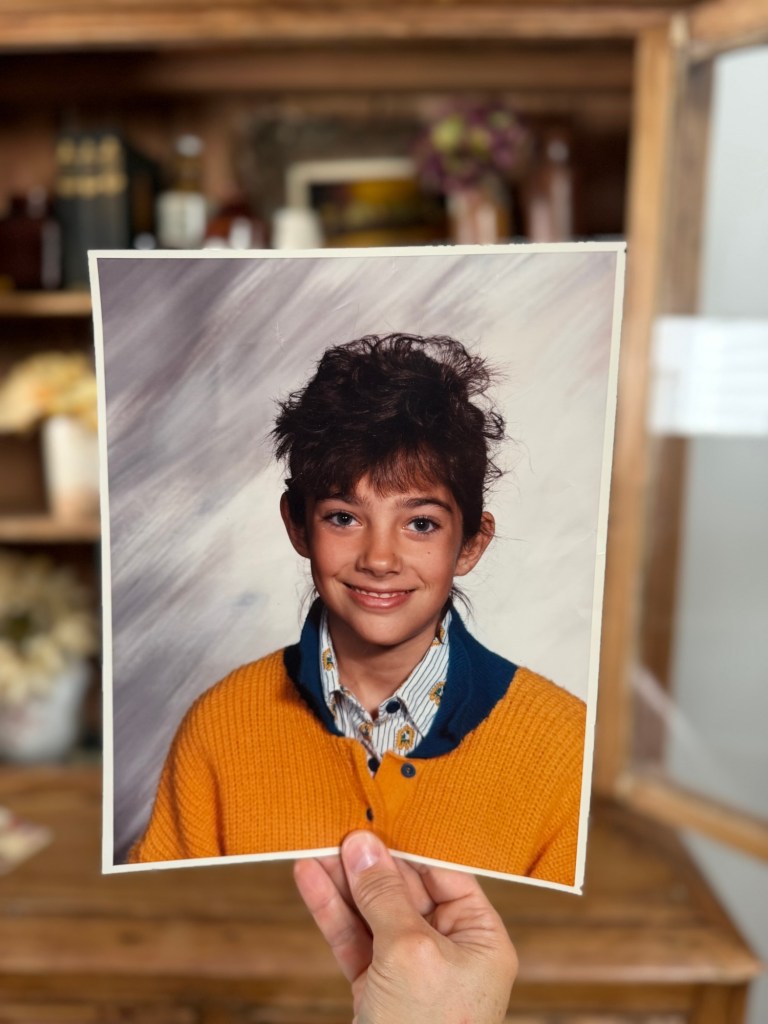
And while my answer still remains that my list is long, I think if I had to choose just one thing, it would be to go back and give that girl, with the rocking bangs, more confidence. But not necessarily the confidence that we usually think about. Not confidence about how I looked or what I wore or whether I was considered cool or not. (Side note, however, I do wish I could have handed her an excellent pair of tweezers to tame that uni-brow.) But what I’m really talking about is the kind of confidence that allows you to be completely comfortable with who you are.
Looking back, I’d say I was a fairly popular kid growing up. But I will add in that I grew up in a very small town, and popularity in a small town doesn’t necessarily mean what you might think it does in good ol’ suburbia. I had friends. I was included. I had boyfriends. I got good grades. I definitely think that I had confidence in some ways. But looking back, I realize how sometimes I molded myself to fit whatever I thought people wanted me to be.
I could read a room. I knew how I thought I was supposed to act around certain people, what I should like, how I should dress, what I should say, and sometimes even who I should be. And that wasn’t necessarily always the same thing depending on who I was around. That said, I think that’s pretty typical for most people.
So much of our younger years are spent trying to figure out where and how we fit in that we forget to ask ourselves a much more important question: Do I like who I’m becoming?
Ironically I think that confidence is one of those gifts that often comes along with age. I have vivid memories of my grandma parading around the mall in her fluorescent jump suit and even brighter fanny pack. I used to be mortified and wonder how she could do that and not worry that everyone was laughing at her. Well, now as a 48-year-old, similarily I find myself walking into Walmart with (very) unwashed hair and quite often wearing my pajamas. And I guarantee people are thinking the same things about me that I thought about my grandma.
But somewhere along the way, you realize that you actually don’t care as much about what everyone thinks of you, or at least you shouldn’t. You become blessed with the IDGAF ‘tude. You understand that the people who truly matter will love you for who you are. You realize that trends come and go, friendships change, opinions change, bodies change (at 48, I can definitely attest to that one!). But at the end of the day, none of those things determine your worth or define who you are.
Eventually you start to gain confidence and become comfortable in your own skin.
I look at my own kids and their friends, and I see how much pressure there is to appear confident and make people think they have all their sh*t together. Sometimes that means dressing a certain way, acting a certain way, being louder, tougher, cooler. But age has made me realize that true confidence does not need an audience. The same way that true happiness does not need to be blasted on social media. You shouldn’t have to (attempt to) prove that you’re better than someone else, just to feel good about yourself. You shouldn’t have to tear someone down to feel taller. You shouldn’t have to change yourself to be accepted. And most importantly, you shouldn’t have to pretend to be someone you’re not.
A wise friend reminded me recently that: people come into our lives for a reason, a season or a lifetime. And maybe that’s another thing I wish I had understood when I was younger.
I’ve been incredibly blessed to have a handful of lifetime friends. And maybe that’s partly because of my small-town upbringing. These are people that have known me through so many different stages of my life. They’ve seen me change, grow, make (countless) mistakes, become a wife, a mom and evolve into so many different versions of myself along the way. I’m certainly not the same person I was at 17, or 25, 32 or even 45. Yet these people never required me to be one particular person to remain their friend. They made room for every version of me. That is such a gift.
Young people are just beginning their lives. And to them, it may seem like every friendship will and has to last forever. Like losing a friend means something went wrong. They feel pressured to hold onto relationships that no longer feel right just so they don’t have to be alone.
But I want my kids, and every kid, to know that they don’t have to be everyone’s friend. On the flip side, that doesn’t give them permission to be unkind. It just means that not every friendship is meant to last a lifetime, and sometimes letting go is how you make room for better people. Some are there for a season. All of them are there for a reason, whether it’s to teach you something, help you navigate through something or even help you discover something about yourself. And if or when your paths go in different directions, it doesn’t mean the friendship failed. Sometimes people just grow in different directions, which is perfectly okay.
At the end of the day, we, as humans, are all looking for the same things. We want to be liked. We want to belong. We want to feel accepted. And most importantly, we want to feel like we are enough.
So if I could sit down with young Amy, I would simply tell her: You are enough. You don’t need to be everything to everyone. You don’t need to change yourself depending on who you’re standing next to. You don’t need anyone’s approval (well, accept maybe my Dad’s.) The people who are meant to be in your life will like you for you. I would tell her to spend less time trying to become the person she thinks everyone wants her to be and instead, spend more time figuring out who she truly is. And then be brave enough to be that person. (And if I’m being completely honest here, I need to tell old Amy these same things.)
I wish confidence was something we didn’t have to grow into. I wish kids would realize from a young age that being comfortable with who they are is far more valuable than being accepted for who they pretend to be. It’s not our job as parents to teach kids how to fit in. It’s making them realize that they never needed to.

